Journal
10 Unique Dining Table Centerpiece Ideas for 2026

Introduction
Your table is more deserving than a sad bowl of fruit that must be whisked away each time anyone actually needs to eat.
Great dining table centerpiece ideas do two things:They look intentional without getting in the way of everyday life. Best centerpieces work just as well for ordering takeout with your spouse as they do for throwing a dinner party, and in 2026, the trend is shifting beyond predictably matching candle sets and supermarked bouquets. This time around, it’s all about objects that tell a story. ”
Regardless if you’re starting with a clean, white plate, or plan to liven up a tablescape that has been largely undisturbed since the Clinton years, there are 10 ideas below that cover the design and price ranges (not to mention, seasonal spectrum) and are guaranteed to have guests exclaim, "Where did you get this?"
10 Unique Dining Table Centerpiece Ideas
⇒01 : A Single Sculptural Vase — Less Is the Whole Point
Sculptural · Minimalist · Year-Round
If the single sculptural vase hasn’t yet earned the signature title of “2026 dining table centerpieces” in your book of interior decor-well, it has.
In reality, it’s more about the ‘what’ than the ‘how,’ though the impact of the one-vase approach should never be underestimated. If your vase truly sings, the most minimal execution-empty, or perhaps with one perfectly chosen stem (think pampas grass or dried eucalyptus branches)-is all you need. Seek out truly artistic vessels that are rich in color (deep emerald green, bold oxblood reds, dramatic blacks) and unique in shape or craftsmanship. Place it in the center of your table-no other objects required.
💡 Styling tip: If the glaze on your vase is vibrantly colored, keep your tablecloth a clean and neutral linen or washed white to let your statement vase take center stage.
→→Discover JINGEE's exquisite ceramic vases → The Ceramic Art:Vases
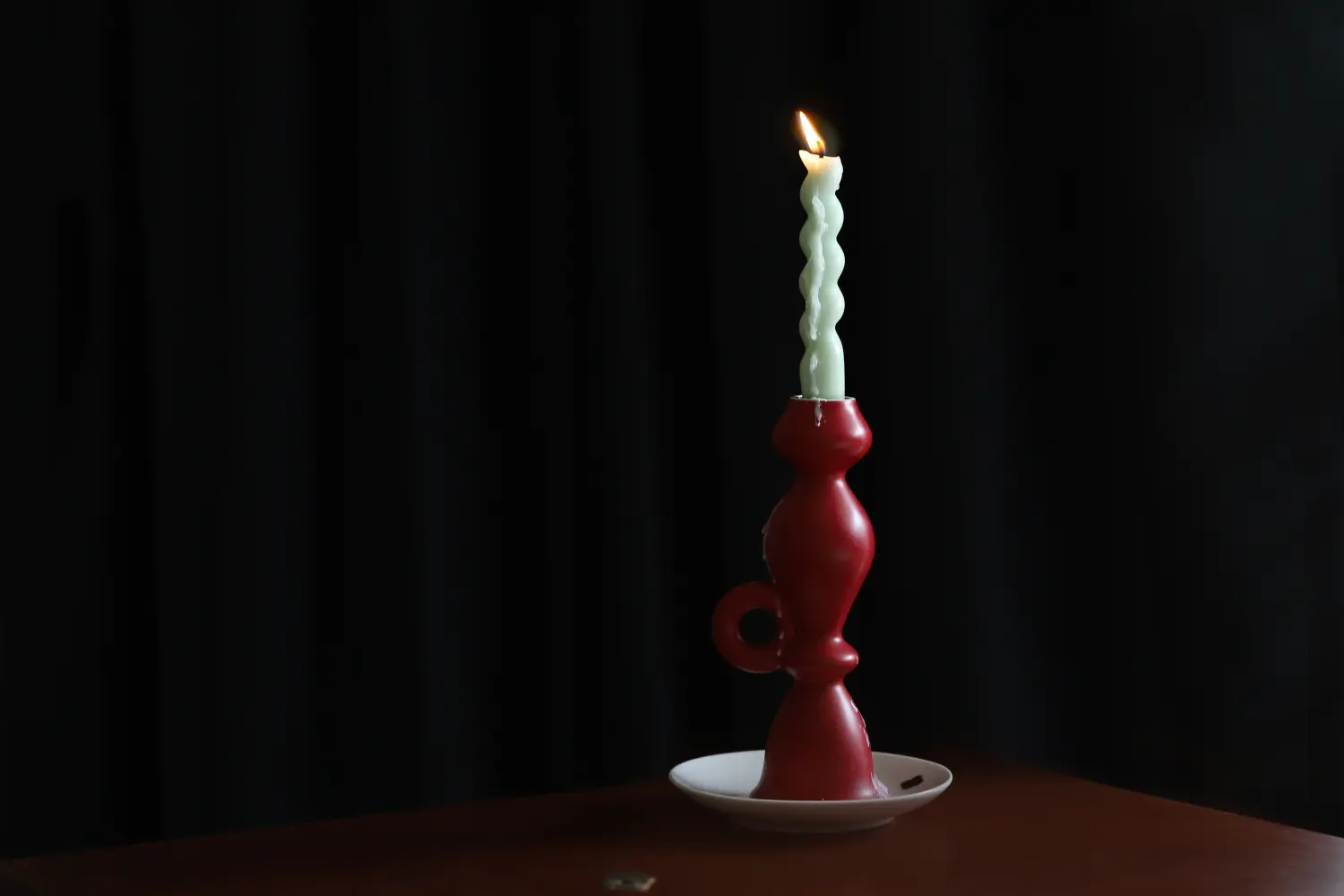
⇒02 : A Low Candle Arrangement — Height Matters More Than You Think
Atmospheric · Dinner Party · Seasonal
One of the biggest dining table centerpiece faux pas is height. Anything that creeps above seated eye-level is a conversation killer.
The key to an atmospheric tabletop:a low, spread-out arrangement. This 2026’s take on dinner party centerpiece is all about a trio of candles set on a decorative dish, tray, or board. Black ceramic holders in unexpected forms, or simple matte holders in rich hues of terracotta and ebony, are ideal for a modern table; traditional three pillar candles can lend warmth for less cash. Stick with neutral ivory in summer, transition to forest greens in December, and experiment with deep burgundy and amber for the autumn season.
💡 Styling Tip: Always aim for an odd number of candles (three or five); anything less can appear stiff or overly formal.
⇒03 :Ceramic Fruit Sculptures — The table Centerpiece That Makes Guests Reach Out and Touch
Conversation Piece · Year-Round · Collectible
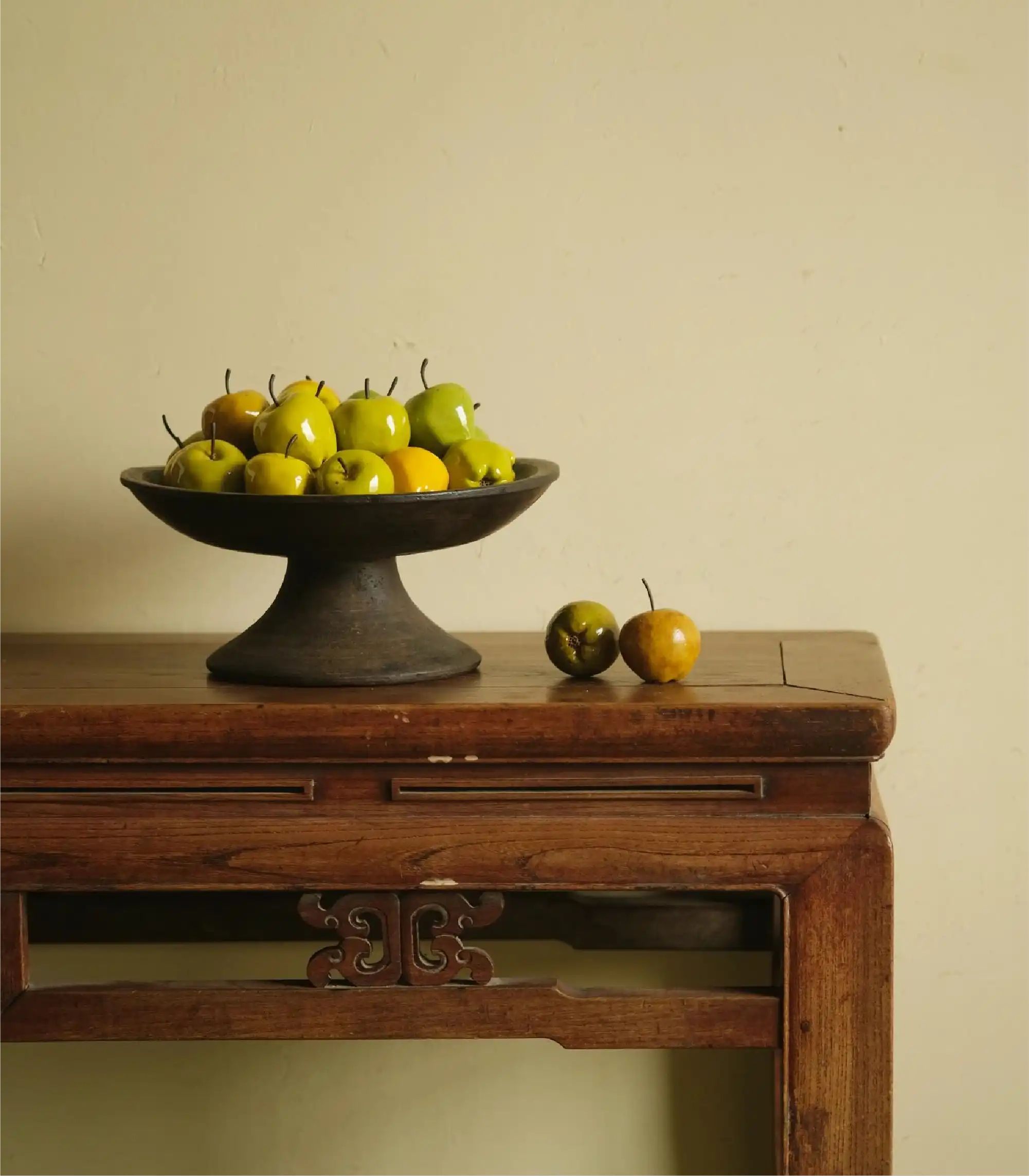
This is the dining table centerpiece idea that requires guests to pause mid-sentence just to reach out and touch.
Crafted to look astonishingly like the real thing, these art-and-decor pieces are unique and conversation-worthy, yet remarkably practical-they never spoil, rot, or require moving to make room for dinner. ) pieces for the greatest visual effect: a bowl of ceramic cherries, a pair of apples, or a melon sculpture with a handful of “cherries” beside it.
Best ceramic fruit sculptures hail from Jingdezhen, China, where each is individually hand-molded, hand-glued, hand-baked, and fired multiple times at different temperatures-giving a fuzzy peach and netted cantaloupe an uncanny verisimilitude.
💡 Styling Tip: The imperfect imperfection is part of the charm of real fruit so emulate that same vibe. Let them sit somewhat askew rather than in a perfectly arranged circle.
→ → Shop Ceramic Fruit Sculptures : The Kiln Garden
⇒04:A Tray of Found Objects — Curated but Not Overdone
Organic · Artisan · Affordable
The dining room table allows for so much personality through a tray-the only problem being that it’s easy to turn a tray from stylish to stuffed with stuff.
To keep your arrangement tasteful rather than tacky, just remember to ruthlessly edit: a maximum of four items should be present, and all should be invited for a reason. (Wooden or marble trays serve as their own distinct boundaries that establish the intention for the arrangement. )
When done well, you will forget there was even a tray at all: Guests will just perceive this arrangement as the sum of the individual parts, not as something that you and I put together for just the occasion.
💡 Styling Tip:The best ratio to use for a tray table centerpiece is 60 percent natural/organic, 30 percent handmade/artisan, and 10 percent unusual. It’s the unusual that you’ll remember.
⇒05:Seasonal Botanicals in an Interesting Container
Seasonal · Fresh · Classic
Fresh flowers will never go out of style as a tabletop centerpiece, but 2026s look emphasizes an heirloom-quality vessel that will transcend seasonal blooms. While the flowers will of course vary from month to month, consider a decorative ceramic bowl, an ornate vase with a striking color or an intricately carved motif, or a sculptural vessel.
During the spring and summer months, this could be a vibrant array of flowers, while in the fall and winter months, it might hold dried branches or a more austere display of evergreen. For a more low-maintenance solution, dried botanical arrangements-of pampas grass, cotton, eucalyptus, orwheat– work beautifully in wide-mouth vases year round, requiring no watering and little upkeep.
💡 Styling Tip:This one is called the "two vase" solution. You'll have a statement ceramic piece that is permanent, and a simpler vase to house fresh flowers or dried botanicals that you swap out.
⇒06:A Collected Object That Travels Well — The Souvenir Table Centerpiece
Personal · Storytelling · One-of-a-Kind
There are home decor stores packed with candidates, but the most chatworthy dining table centerpiece you can display is more than just an item to look at.
Instead, find a piece with history - and, preferably, a provenance story that can spark some table-side conversation. “It can be a singular object with impact: A huge bowl from your travels, a hand-loomed piece of textile... an object bought straight from the maker,” says stylist Carmeon Hamilton. “ The object’s history takes on half of the decorating work.”
As travel and object-based investing ramp up in 2026, this “souvenir-style table centerpieces ” aesthetic is gaining real traction. A beautifully handcrafted item from Jingdezhen - where the practice of pottery has flourished for millennia - possesses that sort of historical gravitas. It's not mass-produced at Big Box retailers. It came from a very specific place, and as soon as it sits at the end of the table, its significance is impossible to miss.
💡 Styling Tip: The strongest collector pieces have clearly visible signs of craftsmanship, whether that’s uneven glaze, an asymmetrical form or the makers’ imprint. These attributes make for conversational conversation, not to mention a talking point!
→ → Shop Unique Handcrafted Gifts — [JINGEE Gift Collection ]
⇒07:A Collected Object That Travels Well — The Souvenir Table Centerpiece
Personal · Storytelling · One-of-a-Kind
Forget trying to create that “wow” moment with a brand new purchase for each and every season. In 2026, it’s more about smart, long-term investment with items that you can reinvent and layer on for different times of year. Choose an impressive, timeless “anchor” centerpiece item, like a large ceramic fruit sculpture, a decorative antique serving dish, or an oversized statement vase that can stand on its own or be artfully supplemented by more seasonal items.
You can supplement by simply changing the color of the accompanying table linens, a simple set of runner and napkins, or adding elements that reflect the season. For example, your sturdy ceramic fruit could be combined with some colorful artificial fall foliage, or paired with a small display of decorative ornaments for a festive winter setting.
💡 Styling Tip: The most flexible table centerpiece pieces don't allude to one season. For example, while a red vase feels Christmassy in December, a yellow vase is season-less and you can mix in a bowl of artificial flowers in the spring and/or a decorative assortment of seashells in the summer.
⇒08:A Tablescape Built Around One Hero Piece
Statement · Dinner Party · Collector
Go for the wow-factor by focusing on one showstopping piece of art or decor as the anchor of your dining table arrangement.
This might be an antique urn, a unique sculpted vase with unusual proportions, a rare collectible object, or even an imposing table centerpiece with a detailed narrative behind it.
Let your single “hero piece” command attention, then keep the rest of your tabletop accessories minimal-perhaps a few slim, elegant tapers in a subtle color palette, and a crisp linen runner. Your arrangement should allow the eye to instantly land on that one magnificent item.
💡Styling tip: Get up and sit in a few different chairs to test how your tablescape works from all vantage points of the table before entertaining.
⇒09:Layered Heights — The Trio Rule
Balanced · Versatile · Design-Forward
Effortlessly elevated tabletops can be attributed to this fail-safe design formula: three elements of varying heights-the tallest placed behind, a shorter piece at either side-arranged in a triangular formation.
- Height 1 (Low, 5–10 cm):Tiny candle holders withvotives, small decorative spheres, or single, perfect piece of fruit.
- Height 2 (Medium, 15–20 cm): A bud vase with a single bloom, a short pillar candle, or a single, carved fig.
- Height 3 (Tall, 25–35 cm): An oversized, sculptural vase, a taper candle in a decorative holder, or an artful branch arrangement.
Place these objects in an invisible triangular formation at the center of the table (rather than a line down the middle) to ensure balance from any seat at the table.
💡Styling Tip: A picture really is worth 1,000 words when it comes to styling balance. Snap a shot from each side of your table and get brutally honest with your camera.
⇒10:The Empty Table — The Centerpiece That Isn't There
Minimalist · Modern · Intentional
It takes a certain confidence-bordering on artistic rebellion-but the most impactful table centerpieces this year may be no centerpieces at all. Or rather, simply an exquisite tablecloth or runner, entirely unadorned. The trend is born from the fact that most every dining table has something on it these days; a bare tabletop in 2026 becomes a statement piece in itself.
If your table is the artwork (thinklive-edge wood, stone tabletops, or an intriguing silhouette), let it shine.
If this concept feels too spare, you can break the rules by placing one carefully considered object offset to one side of the table, as though someone momentarily set it down-leaving the vast majority of negative space to do the work.
💡Styling tip:If your choice is to go minimalist, the linens really must be spectacular. A mediocre cloth and nothing atop it will look less than chic. A divine, hand-loomed table runner with nothing but…nothing…and a stunning wooden table could be the pinnacle of modern interior design.
Conclusion:The best dining table centerpiece is the one you will actually keep
The consistent thread linking all these table centerpiece ideas together is their ability to last, to be of such quality or personal meaning that they are not treated as throwaway decor that needs to be replaced every time an event looms. The bag of oranges you haul into the dining room only when guests are due to arrive? Not a centerpiece. ” That’s a centerpiece.
A sculptural vase that’s transformed by the way the morning light hits it vs. The warm glow of a candle - now that’s a centerpiece. Your dining room should, as of 2026, be as curated and story-rich as the other spaces in your home. Start with an item you’re madly in love with and build around that.
【Internal Links Section】
→ Explore ceramic fruit sculptures for your dining table: The Kiln Garden Collection [https://jingeeo.com/product-category/the-kiln-garden-sculptural-fake-fruit/]
→ Shop handcrafted vases and candle holders: Ceramic Art [https://jingeeo.com/ceramic-art/]
→ Find a unique housewarming or hostess gift: Gift Guide [https://jingeeo.com/handmade-ceramic-gifts/]
Frequently Asked Questions
Q: What makes a good dining table centerpiece?
A: A good dining table centerpiece is a decorative piece that is visually appealing and doesn’t interfere with the dining experience. Ideally, it’s kept below eye level so guests can see each other clearly. It should also look attractive from all sides of the table, as the position may shift or the guests may move around.
Q: How tall should a dining table centerpiece be?
A: For most everyday dining, aim for table centerpiece no higher than 10-12 inches (25-30 cm) to avoid blocking conversation. For special occasions where a striking effect is desired or guests are seated on one side of the table (e. , buffet), taller pieces may be suitable.
Q: What are the best year-round dining table centerpiece ideas?
A: For year-round dining table centerpieces, choose items that are timeless and not season-specific. This includes unique ceramic pieces, interesting vases, artistic sculptures, collections of well-chosen objects, and high-quality candle holders. Ceramic fruit sculptures in neutral colors or that can be layered with seasonal accents, are particularly versatile for throughout the year.